Learning Beyond Paper: What Meaningful, Hands-On Early Learning Looks Like at Highpointe Academy
Quick Answer
Hands-on, play-based learning gives young children concrete ways to explore ideas, practice skills, and build understanding that transfers to new situations. At HighPointe Academy, children at our Castle Pines, Castle Rock, and Saddle Rock locations learn through real materials, meaningful experiences, conversation, and exploration every day.
This Learning Beyond Paper approach reflects an important part of early childhood education: young children learn by actively engaging with the world around them.
What Happens When Children Learn With Their Hands
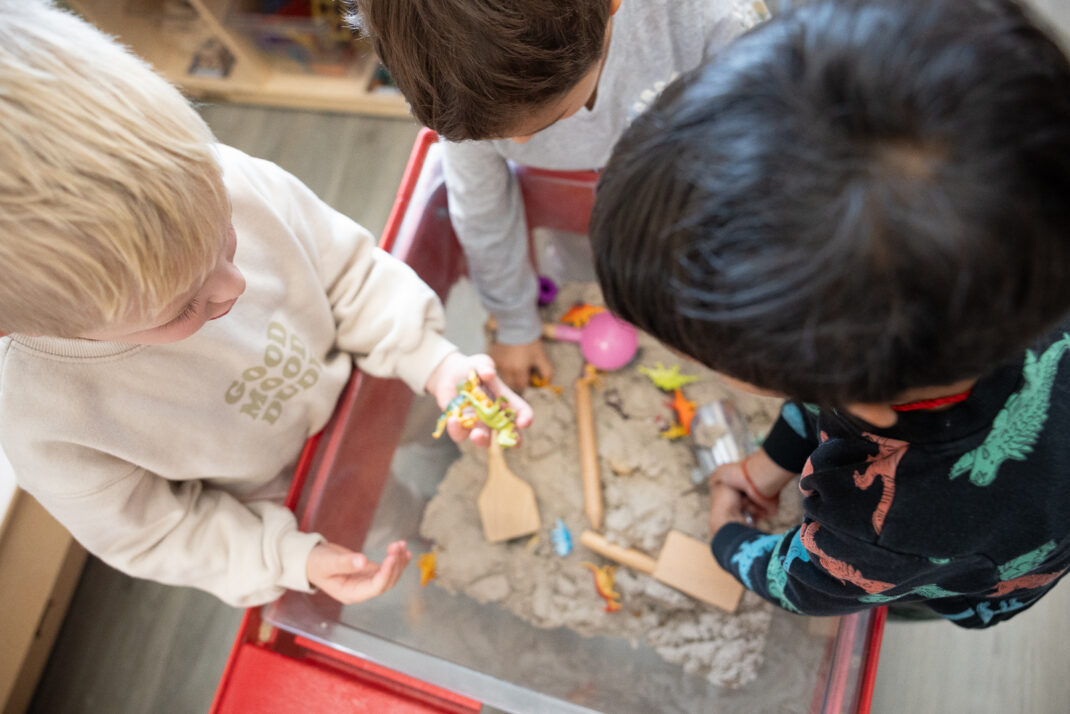
Young children learn through physical experience. A 2018 review published by the Encyclopedia on Early Childhood Development found that hands-on, active learning approaches support the development of executive function, language, and social skills more effectively than passive instruction in the early years. Children this age build understanding by handling, building, spilling, sorting, comparing, and trying again.
At Castle Pines, Castle Rock, and Saddle Rock, , that finding shapes what children encounter every day across all three campuses. A morning in one classroom might include a child filling and emptying containers at a water table, discovering on their own that a wide bowl holds more than a narrow one. Another child at a neighboring table might be pressing leaves into clay and noticing the difference between a smooth edge and a jagged one. Neither activity comes with a worksheet or a right answer. Both involve focused attention, physical engagement, and real discovery.
When children regularly work with open-ended materials, they practice making choices, adjusting plans, and returning to a problem when the first attempt does not work. Those habits carry into later learning in ways that paper-and-pencil practice at this age typically cannot replicate.
What Learning Looks Like in the Block Area, the Garden, and Beyond
Across Castle Pines, Castle Rock, and Saddle Rock, educators design spaces where learning is embedded in the materials themselves. Children do not need a separate lesson to encounter a concept when the concept is already present in what they are handling.
In the block areas, children negotiate, plan spatially, and make structural decisions. When a tower falls, they consider what changed and try a different arrangement. When two children want to build in the same space, they figure out how to share it. A project that takes three days to complete builds persistence alongside engineering thinking.
Outdoor spaces give children time with textures, weights, distances, and living things. A garden bed where children plant seeds, water them, and track changes over several weeks connects observation, patience, and cause-and-effect reasoning. A child who notices that the bean sprout grew after a rainy day is making a scientific connection, not from a textbook, but from watching.
Dramatic play areas let children rehearse language and social knowledge. A child playing the role of a restaurant server takes orders, remembers them, and responds to requests. The scenario is imaginative, but the skills being practiced are real. Vocabulary grows, memory is exercised, and collaboration is required.
How Educators Support Learning Without Directing It
At Castle Pines, Castle Rock, and Saddle Rock, educators act as facilitators. They set up environments with intention, observe what children are drawn to, and ask questions that extend the thinking already happening. When a child finishes building a ramp and announces that the ball rolls faster on the smoother surface, the educator might ask what would happen with a longer ramp or a heavier ball. The child’s curiosity leads the inquiry.
This approach reflects the NAEYC position on intentional teaching, which describes high-quality early childhood educators as professionals who make thoughtful decisions about when to step in, when to step back, and how to use children’s interests as entry points for deeper learning. Intentional teaching in a play-based setting looks different from direct instruction, but it is no less purposeful.
Educators across Castle Pines, Castle Rock, and Saddle Rock locations plan with observation data, adjusting materials and invitations based on what children are currently interested in and working through. A classroom question about shadows becomes a week-long investigation. A child’s fascination with insects shapes a series of experiences in the outdoor space. The curriculum follows the children’s thinking rather than moving them through a predetermined sequence.
Learning Beyond Paper Across Three Locations
If you have been looking at early childhood programs in the greater Denver area or nearby communities like Castle Pines, Castle Rock, or southeast Aurora, you may have noticed that schools describe their approach to learning in very different terms. At HighPointe Academy, hands-on learning is not a supplement to the curriculum. It is the curriculum, visible across three campuses — Castle Pines, Castle Rock, and Saddle Rock — that share the same commitment to active, child-led exploration.
Frequently Asked Questions
What does hands-on learning actually look like in a typical school day?
Hands-on learning can happen throughout the day through building, sensory experiences, dramatic play, art, outdoor exploration, classroom activities, and collaborative projects. Children have opportunities to interact with materials, ask questions, make choices, and work through problems while educators support their learning.
How do educators make sure children are actually learning, not just playing?
Play and learning are closely connected during early childhood. Educators observe how children interact with materials, solve problems, communicate, collaborate, and develop new skills. Teachers can then use those observations to provide experiences that continue supporting each child’s development.
Is hands-on learning enough preparation for kindergarten?
Hands-on early learning gives children opportunities to practice many of the skills they will use in kindergarten, including communication, problem-solving, self-regulation, independence, collaboration, and persistence. These skills help create a foundation for future academic learning.
Do Castle Pines, Castle Rock, and Saddle Rock follow the same learning approach?
HighPointe Academy’s three locations share a focus on meaningful, hands-on early learning. Individual classroom experiences and program offerings may vary by location and age group, so families can learn more about their specific school’s programs during a tour.
A Closer Look Is Worth It
Reading about hands-on learning and seeing it happen are two different experiences. Visiting a classroom gives families an opportunity to see how children interact with their teachers, peers, materials, and environment throughout the day.
Families can schedule a tour at HighPointe Academy – Castle Pines, HighPointe Academy – Castle Rock, or HighPointe Academy – Saddle Rock to explore the school, meet the educators, and see what Learning Beyond Paper looks like in practice.
Related Posts
All Posts
Beyond Free Play: The Skills and Milestones Behind Play-Based Curriculum
The Hidden Structure Behind Play: What Quality Looks Like in Practice